For years, digital marketers have treated Black Friday as a simple exercise in brute-force traffic acquisition and static discount banners. Leadership teams pump capital into programmatic ad networks, expecting automated attribution tools to reliably track every transactional touchpoint across the digital ecosystem. Yet as commercial activity shifts toward conversational interfaces and generative engines, that traditional funnel attribution model is breaking down. When shoppers bypass search engines entirely, entering bespoke prompt sequences into conversational models to aggregate discount codes, compare historical pricing, and evaluate product specifications across dozens of merchant sites, retail architecture faces an entirely new operational reality. Algorithmic personalization and conversational AI are fundamentally reshaping Black Friday Sale 2026, requiring brands to replace traditional funnel attribution with dynamic behavioral intelligence.
The Breakdown of Static Funnels Under Conversational Query Pressure
Modern shoppers, particularly digital natives within Generation Z, no longer navigate e-commerce sites via traditional keyword searches and category pages. Instead, they rely on generative query tools to synthesize deals, compare alternatives, and parse promotional terms across the web. This behavioral shift exposes the structural fragility of legacy retail architectures. When a shopper deploys a multi-part prompt to extract promotional discounts, evaluate warranty terms, and cross-reference inventory levels, they are not interacting with a standard landing page. They are interacting with a generative synthesis engine that abstracts the storefront entirely.
Recent empirical research into generative engine optimization demonstrates that content visibility in automated responses depends heavily on structured data schemas and explicit quantitative citations (Aggarwal et al., 2024). Traditional keyword stuffing and vanity landing pages fail to influence these generative engines. When merchants fail to structure their product data for machine readability, they become invisible to conversational shopping agents. Apparently, giving an LLM read access to six databases and zero structured metadata boundaries is now considered an enterprise retail strategy.
The underlying technology governing how conversational models process discount queries relies increasingly on adaptive inference allocation. Rather than depending purely on static parameter scale, modern models leverage test-time compute strategies to reason through complex multi-step user prompts (Snell et al., 2024). When a buyer asks an AI assistant to find the absolute lowest price for a consumer electronics item across verified merchants while factoring in shipping fees and cash-back rewards, the underlying model executes iterative verification steps. If enterprise commerce APIs are not built to feed clean, real-time structured data into these reasoning loops, brands are systematically excluded from the recommendation set.
Navigating Cognitive Friction and Algorithmic Recommendation Heuristics
The intersection of artificial intelligence and digital commerce introduces profound cognitive shifts in how consumers evaluate value. Academic examinations of artificial intelligence in e-commerce emphasize that algorithmic systems fundamentally transform customer experiences and data-driven decision-making across retail touchpoints (Dileesh et al., 2026). However, this technological integration creates new friction points for both buyers and brand strategists.
When buyers delegate discount discovery to conversational agents, traditional pricing psychology dissolves. Consumers no longer compare discounts against an arbitrary manufacturer suggested retail price presented on a brand website. Instead, they evaluate options through synthesized comparative summaries generated by conversational interfaces. These interfaces operate on recommendation heuristics that prioritize factual density, verified inventory metadata, and transparent pricing structures.
In my view, enterprises that continue to view conversational AI as a mere novelty channel are missing the foundational shift in buyer autonomy. What this means in practice is that commercial strategy must pivot from capturing human attention via visual flash to satisfying machine readability requirements. If an enterprise product catalog lacks semantic markup adhering to standard machine-readable vocabularies (W3C Schema.org Community Group, 2024), conversational agents will bypass that inventory entirely in favor of competitors with transparent structured data.
Operational Vulnerabilities in Real-Time Commercial Execution
Relying on legacy our stacks to manage conversational commerce during high-volume events like Black Friday creates severe operational risks. Enterprise data pipelines often struggle to maintain synchronization between real-time inventory levels, dynamic pricing engines, and external conversational agents querying backend endpoints.
Furthermore, integrating AI-driven discovery tools without robust risk management structures exposes brands to systemic errors, automated scraping exploits, and margin erosion caused by unvalidated promotional stacking. Organizations must approach AI deployment with structured risk governance principles, drawing on established frameworks like the NIST AI Risk Management Framework to evaluate system reliability, data integrity, and operational safety (National Institute of Standards and Technology, 2023). Without such oversight, automated prompt-driven discounting can trigger unintended margin collapses when conversational agents discover and exploit legacy API loopholes.
Strategic Interventions for Enterprise Commerce Leaders
To successfully navigate conversational commerce and behavioral intelligence during high-stakes sales events, enterprise leaders must execute three targeted operational changes:
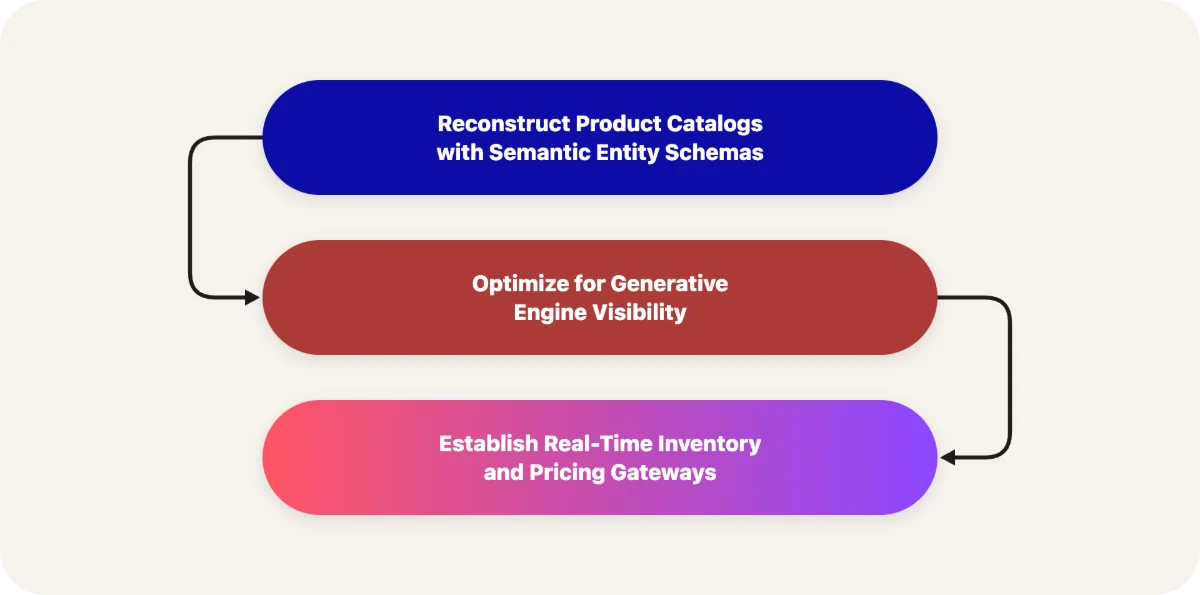
- Reconstruct Product Catalogs with Semantic Entity Schemas: Implement W3C-compliant JSON-LD markup across all product, pricing, and inventory endpoints to ensure generative engines can accurately parse and cite corporate inventory during conversational queries (W3C Schema.org Community Group, 2024).
- Optimize for Generative Engine Visibility: Incorporate verified quantitative statistics, clear pricing conditions, and authoritative documentation directly into product metadata. Research shows that structured content optimization can boost visibility in generative engine responses by up to 40% compared to traditional keyword methods (Aggarwal et al., 2024).
- Establish Real-Time Inventory and Pricing Gateways: Deploy strict middleware rate-limiting and authorization boundaries between public-facing conversational APIs and core inventory databases to prevent automated scrapers and conversational agents from executing unauthorized multi-code discount stacking.
Executive Takeaway
The transition from static funnel attribution to behavioral intelligence is no longer an abstract theoretical debate for digital strategists. As conversational interfaces and generative engines intermediate the consumer journey, traditional advertising metrics lose their predictive power. Enterprises that survive this transition will be those that treat their data infrastructure as an API-first knowledge graph, ensuring that their pricing, inventory, and product claims are fully optimized for machine reasoning and conversational discovery.
References
- Aggarwal, P., Murahari, V., Rajpurohit, T., Kalyan, A., Narasimhan, K., & Deshpande, A. (2024). GEO: Generative Engine Optimization. Proceedings of the 30th ACM SIGKDD Conference on Knowledge Discovery and Data Mining (KDD '24), 5-16. DOI: 10.1145/3637528.3671900
- Dileesh, L. C., Vrendha, M., N, F. F., Nazrin, N., & Ummer, S. (2026). A Study of Artificial Intelligence In E-commerce: Applications, Benefits, Challenges and Future Trends. International Journal of Technology & Emerging Research. DOI: 10.64823/ijter.2621016
- National Institute of Standards and Technology. (2023). Artificial Intelligence Risk Management Framework (AI RMF 1.0). U.S. Department of Commerce. https://nvlpubs.nist.gov/nistpubs/ai/NIST.AI.100-1.pdf
- Snell, C., Lee, J., Xu, K., & Kumar, A. (2024). Scaling LLM Test-Time Compute Optimally can be More Effective than Scaling Model Parameters. arXiv Preprint. https://arxiv.org/abs/2408.03314
- W3C Schema.org Community Group. (2024). Schema.org structured data schemas for generative search systems and entity graphs. World Wide Web Consortium. https://schema.org/docs/documents.html