The enterprise AI market is currently obsessed with the wrong metric. While hyperscalers trade blows over trillion-parameter counts and massive capex investments in H100 clusters, a quieter and more significant revolution is occurring at the architectural level. The emergence of tools like Graphify-Labs/graphify, which converts complex codebases, SQL schemas, and configurations into queryable knowledge graphs, signals a departure from the "brute force" scaling era. We are entering a phase where the efficiency of architectural reasoning and the precision of inference outweigh raw model size. For the executive leader, this shift represents a move from high-risk, black-box experiments toward deterministic, systems-oriented AI that actually understands the underlying business logic.
The Trillion Parameter Wall and the Return to Structure
For the past two years, the prevailing enterprise strategy has been to wait for the next foundation model to solve the problem of context. The assumption was that if the context window grew large enough or the parameters reached a certain threshold, the model would magically "understand" a legacy ERP system or a spaghetti-code microservices architecture. Reality has been less forgiving. Large Language Models (LLMs), are exceptional at pattern matching but historically poor at precise architectural manipulation and accessing up-to-date domain knowledge (Lewis et al., 2020).
In my view, the industry is finally hitting a wall where raw scale cannot compensate for a lack of structural awareness. When an agent attempts to navigate a complex SQL schema using only vector-based Retrieval-Augmented Generation (RAG), it often misses the relational nuance that defines the system. The "Naive RAG" approach, which relies on simple semantic similarity, frequently fails to capture the intricate dependencies between a configuration file and a database constraint (Gao et al., 2023). Graphify addresses this by replacing fuzzy vector searches with local deterministic Abstract Syntax Tree (AST), parsing. It creates a map where every edge is explained. Apparently, the industry has spent billions trying to teach LLMs to guess how code works when we could have just given them the map all along.
The Shift in Enterprise AI Economics
This structural approach changes the fundamental math of AI deployment. Currently, enterprise AI economics are dominated by the high costs of long-context inference and the latency penalties of massive models. When you treat a codebase as a flat text file, you burn tokens on irrelevant "noise" just to ensure the model sees the "signal."
By moving the reasoning mechanism into a structured knowledge graph, organizations can shift their investment from token-heavy compute toward inference efficiency. Architectural reasoning allows for a more surgical application of model power. Instead of sending 100,000 tokens of raw documentation to a flagship model, a system using structured parsing identifies the exact dependencies required for a task. This facilitates the use of smaller, distilled models that operate with lower latency and higher speculative decoding efficiency.
The economic implication is clear: competitive advantage no longer belongs to the firm with the biggest GPU budget, but to the firm with the highest "reasoning-to-token" ratio. This shift aligns with broader institutional mechanisms of trust transfer. Just as trust in e-commerce transfers from a robust platform to individual sellers, trust in AI outputs transfers from a deterministic, verifiable architecture to the resulting decision (Chen et al., 2015). If the architecture is transparent and explainable, the executive can authorize higher levels of autonomy.
Deterministic Mechanisms vs. Stochastic Guesswork
The technical core of this shift lies in how we bridge the gap between parametric memory and external data. Foundational research established that RAG is essential because models cannot manipulate knowledge with total precision on their own (Lewis et al., 2020). However, the evolution from Naive RAG to Modular RAG (Gao et al., 2023), requires a deeper understanding of system interactions.
Graphify implements a mechanism that mirrors the "ReAct" framework, where models interleave reasoning traces with specific actions (Yao et al., 2023). By generating a knowledge graph from a codebase, the AI can "act" by traversing defined edges rather than "dreaming" about potential code relationships. This interleaving of plan and action reduces the hallucination rates that plague standard chain-of-thought processing.
I think the most significant breakthrough here is the move away from the vector store as the sole source of truth. Vector databases are excellent for finding "things that sound like other things," but they are notoriously bad at finding "the exact line of code that governs the discount logic in the 2022 pricing module." Deterministic AST parsing provides that exactness. It allows the system to handle exceptions and update its understanding as the codebase evolves, much like how circular mechanisms in other complex systems allow for continuous, sustainable feedback loops (Nguyen et al., 2025).
Risk Management in a Structured Environment
From a governance perspective, the move toward structured, graph-based AI is a prerequisite for compliance with emerging standards. The NIST AI Risk Management Framework (AI RMF 1.0), emphasizes the need for systems that are trustworthy, explainable, and accountable (NIST, 2023). When an AI system operates on a "black box" vector index, providing provenance for a decision is difficult.
When the underlying data is structured as a queryable graph where "every edge is explained," the path to accountability becomes clearer. This is particularly vital when extending these frameworks to generative AI profiles where the risks of outdated knowledge and untraceable reasoning are amplified (NIST, 2024). A structured architecture provides the guardrails necessary to move AI from a "creative assistant" to a "production engineer."
Pragmatic Steps for Technical Leadership
If your organization is currently struggling to get measurable ROI from generative AI agents, the problem is likely not the model, but the lack of a structural bridge between the model and your technical reality. To move beyond the siloed experiment phase, I suggest the following actions:
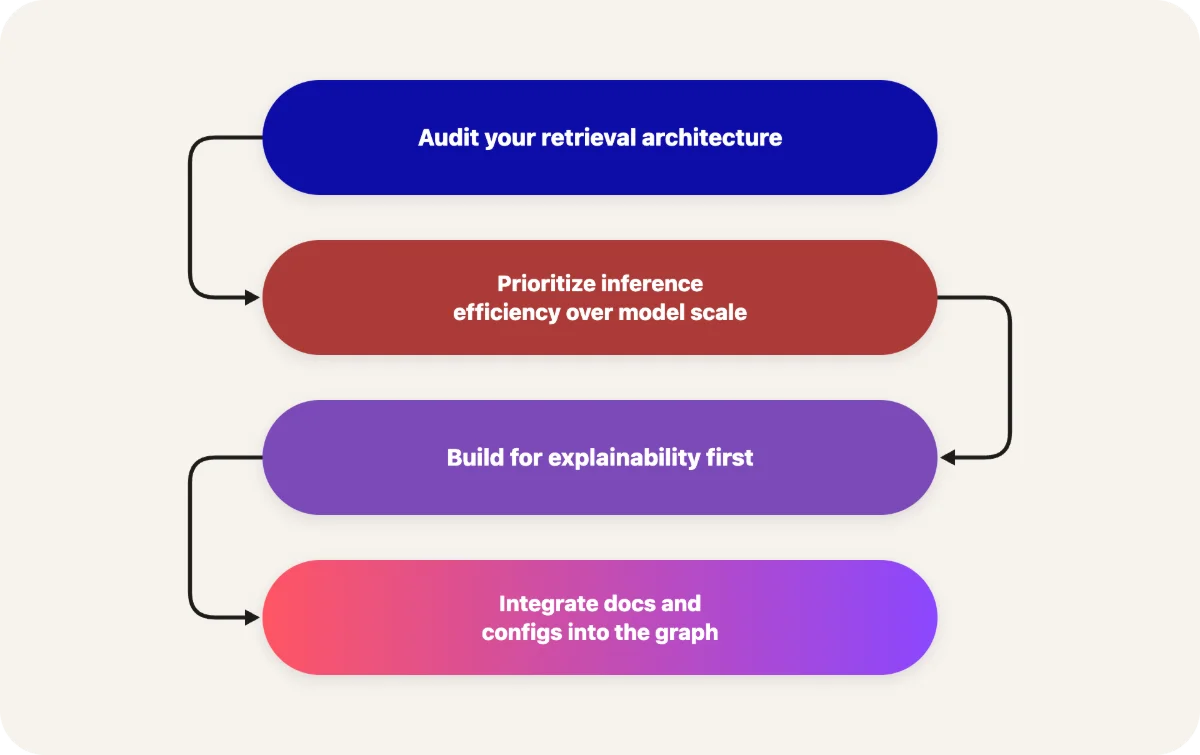
1. Audit your retrieval architecture
Evaluate whether your current RAG implementation relies too heavily on semantic similarity. If your agents are failing on tasks involving SQL schemas or complex configurations, move toward deterministic parsing and graph-based indexing. You cannot solve a structural problem with a bigger embedding model.
2. Prioritize inference efficiency over model scale
Redirect a portion of your LLM budget toward improving the "cleanliness" of the data fed into the prompt. Small, fine-tuned models running on structured graphs often outperform flagship models running on raw text. Measure your success by the reduction in tokens required to solve a complex architectural query.
3. Build for explainability first
Implement tools that provide a "reasoning trace" for every action the agent takes. Ensure that if an agent suggests a change to a database schema, it can point to the specific nodes in your knowledge graph that justify the recommendation. This is not just a technical requirement; it is a governance necessity under the NIST AI RMF guidelines (NIST, 2023).
4. Integrate docs and configs into the graph
Do not treat documentation as a separate entity from the code. A system like Graphify thrives when it can map a line of code to its corresponding documentation and its deployment configuration. This creates a "System of Systems" view that breaks down the silos between development, DevOps, and business logic.
The Architecture of Certainty
The era of the "expensive intern" model of AI is ending. We have seen what happens when we give a powerful LLM a massive context window but zero structural guidance: we get confident hallucinations and exceptionally high API bills. The shift toward architectural reasoning mechanisms represents a maturation of the market.
In my view, the winners in the next phase of enterprise AI will be those who stop treating code and data as a pile of strings and start treating them as a coherent system. Tools that can turn a messy codebase into a deterministic map allow us to move from the stochastic guesswork of the past two years toward a future of operational certainty. We don't need models that are larger; we need architectures that are smarter.
References
- Chen, X. S., Huang, Q., Davison, R. M., & Hua, Z. (2015). What Drives Trust Transfer? The Moderating Roles of Seller-Specific and General Institutional Mechanisms. International Journal of Electronic Commerce. DOI: 10.1080/10864415.2016.1087828
- Gao, Y., Xiong, Y., Gao, X., Jia, K., Pan, J., Bi, Y., Dai, Y., Sun, J., Wang, M., & Wang, H. (2023). Retrieval-Augmented Generation for Large Language Models: A Survey. arXiv Preprint. https://arxiv.org/abs/2312.10997
- Lewis, P., Perez, E., Piktus, A., Petroni, F., Karpukhin, V., Goyal, N., Küttler, H., Lewis, M., Yih, W.-t., Rocktäschel, T., Riedel, S., & Kiela, D. (2020). Retrieval-augmented generation for knowledge-intensive NLP tasks. Advances in Neural Information Processing Systems (NeurIPS), 33, 9459-9474. https://arxiv.org/abs/2005.11401
- National Institute of Standards and Technology. (2023). Artificial Intelligence Risk Management Framework (AI RMF 1.0). U.S. Department of Commerce. https://nvlpubs.nist.gov/nistpubs/ai/NIST.AI.100-1.pdf
- National Institute of Standards and Technology. (2024). Artificial Intelligence Risk Management Framework: Generative Artificial Intelligence Profile (NIST AI 600-1). U.S. Department of Commerce. https://nvlpubs.nist.gov/nistpubs/ai/NIST.AI.600-1.pdf
- Nguyen, T. H., Wang, X., Utomo, D. S., Gage, E., & Xu, B. L. (2025). Circular bioeconomy and sustainable food systems: What are the possible mechanisms?. Cleaner and Circular Bioeconomy. DOI: 10.1016/j.clcb.2025.100145
- Yao, S., Zhao, J., Yu, D., Du, N., Shafran, I., Narasimhan, K., & Cao, Y. (2023). ReAct: Synergizing reasoning and acting in language models. International Conference on Learning Representations (ICLR). https://arxiv.org/abs/2210.03629