The enterprise AI narrative has spent two years trapped in a simplistic arms race focused purely on parameter volume. Boardrooms and engineering summits celebrated brute-force scaling curves under the naive assumption that larger models naturally produce proportional commercial value. That illusion is rapidly dissipating. For the enterprise architect and Chief Information Officer, raw capacity without architectural discipline is just an accelerated path to unmanageable inference bills and unpredictable agent loops.
Alibaba’s official launch of Qwen4-Max marks a clear departure from brute-force token generation toward task-oriented execution economics. With a 2.4-trillion-parameter Mixture-of-Experts (MoE), backbone activating approximately 71 billion parameters per token, coupled with an auxiliary 328-billion-parameter N-gram embedding layer, the model is engineered around a singular operational reality: enterprise autonomous agents require high-resolution reasoning across long horizons without consuming millions of redundant tokens.
In my view, the most consequential metric in this release is not the 1-million-token context window or the top-line benchmark score. It is the reported 62% reduction in end-to-end task execution costs observed across extensive industrial benchmarks. When an architecture cuts token consumption by nearly half on terminal and workflow environments, it changes the fundamental economics of deploying autonomous agents inside enterprise software estates.
The Mechanical Reality: Sparse MoE Activation and N-Gram Embeddings
To understand why this release matters beyond marketing headlines, leadership teams must look at the mechanical innovations powering the architecture. Dense models suffer from quadratic compute overhead when scaled to trillions of parameters. By utilizing a sparsely activated Mixture-of-Experts framework, Qwen4-Max decouples total knowledge capacity from per-token compute expenditure.
During inference, routing gate networks direct incoming token representations only to specialized feed-forward expert subnetworks. With 71 billion active parameters per forward pass, the model achieves the representational fidelity of a multi-trillion-parameter foundation model while retaining the latency profile and memory bandwidth requirements of a much leaner system.
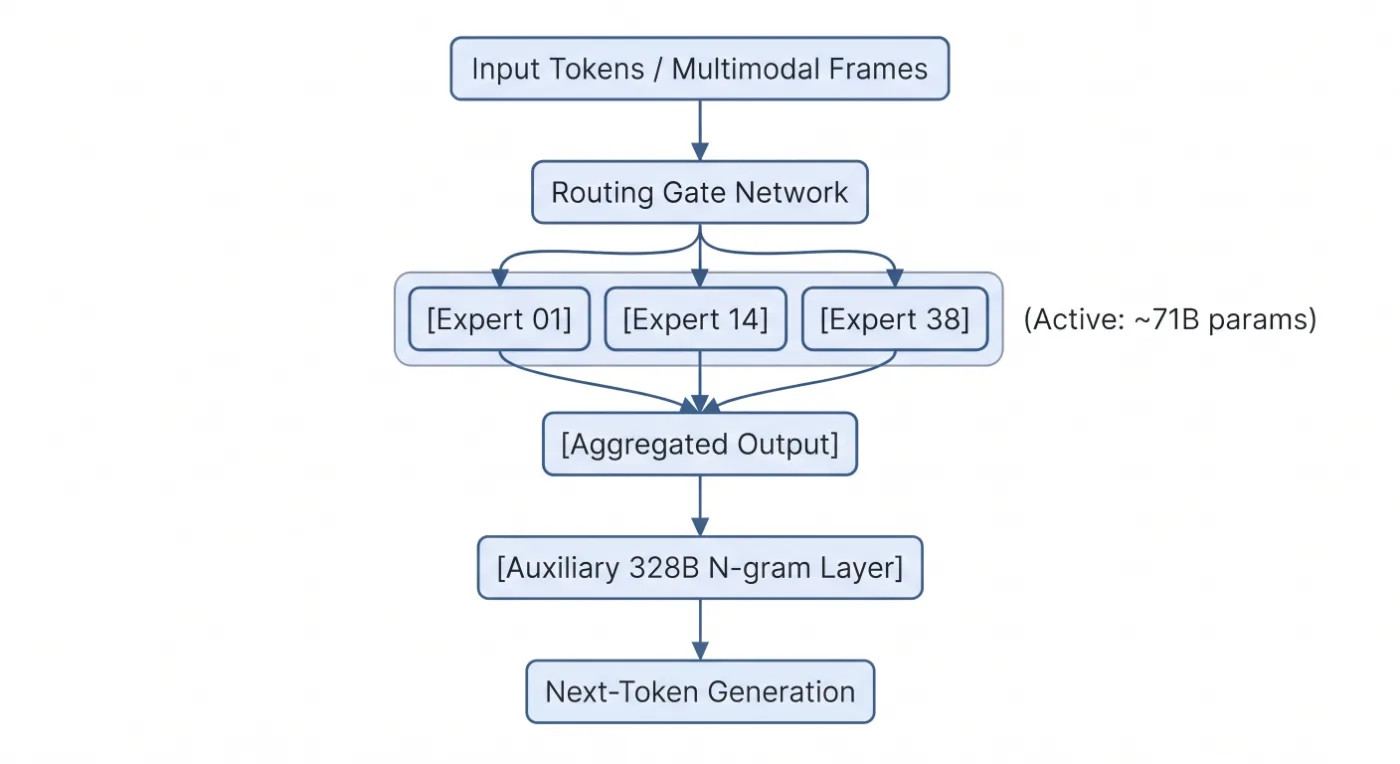
The introduction of an auxiliary 328-billion-parameter N-gram embedding layer serves an equally critical mechanical function. In complex agentic trajectories, repetitive structural syntax, code boilerplate, JSON schemas, and recurring phrasing consume significant computational bandwidth. By accelerating token prediction over multi-token sequences via specialized N-gram representations, the system alleviates pressure on the primary attention mechanisms, stabilizing execution throughput during deep reasoning loops.
This mechanical balance directly addresses the long-horizon context challenges documented by researchers. As Yao et al. (2023) demonstrated, interleaving reasoning traces with discrete tool executions (ReAct), significantly improves task success rates, yet standard models frequently derail over multi-turn interactions due to context drift and runaway token consumption. When an architecture natively minimizes token bloat across iterative cycles, the probability of agent trajectory collapse drops substantially.
Work360 and Terminal-Bench 4.0: Benchmarking the Enterprise Reality
Standard academic benchmarks such as MMLU or simple zero-shot trivia tests have outlived their enterprise relevance. They measure factual memorization rather than operational competence.
The evaluation metrics accompanying Qwen4-Max focus on applied enterprise workloads through the Work360 benchmark, an internal taxonomy spanning 26 top-level domains, 182 subdomains, and 721 specialized industry fields ranging from precision manufacturing and financial reconciliation to statutory compliance. On Work360, Qwen4-Max scored 52.69 (surpassing Qwen3.8-Max at 47.74), while consuming 24% to 35% fewer tokens depending on reasoning effort configuration.
This token reduction translates directly to unit economics: average per-task execution spend dropped from $4.43 down to $1.67.
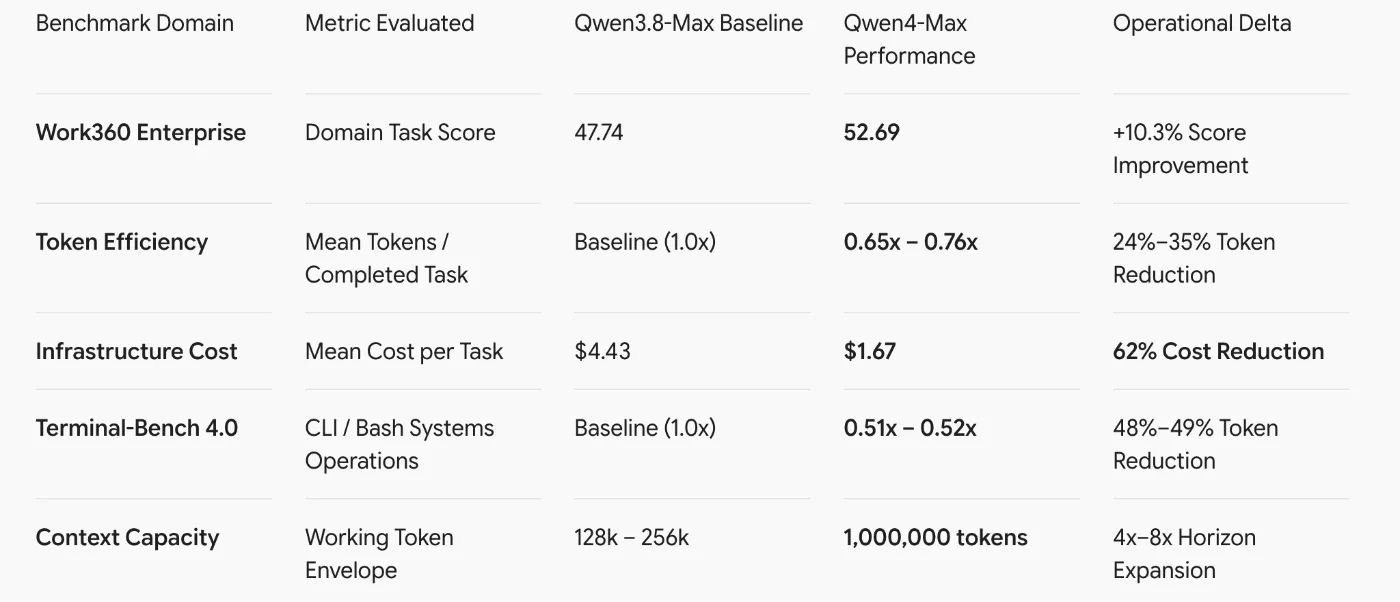
On Terminal-Bench 4.0, which evaluates an AI’s ability to interact with shell environments, debug Linux environments, manipulate repositories, and execute operational scripts, the model reduced token usage by 48% to 49%. Anyone who has built production coding agents knows that runaway terminal loops represent a massive operational expense. An agent that resolves a broken build in 12 concise bash commands instead of 60 erratic trials saves compute capital and preserves operational safety.
In their analysis of agentic software engineering systems, Hasan and Biswas (2026), observed that operational failures in code assistants frequently stem from uncontrolled tool execution boundaries and compounding execution errors rather than deliberate malice. When foundation models operate with tighter token economy, they generate fewer noisy reasoning steps that trigger downstream execution failures.
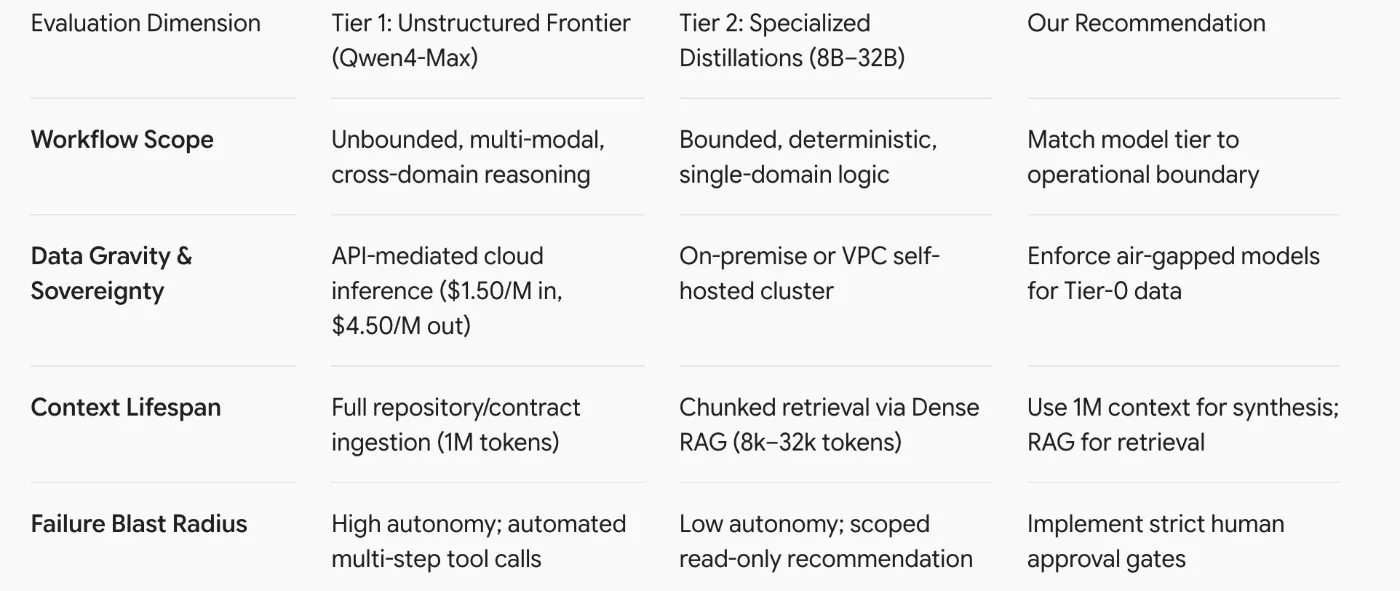
AIMarTech Framework: Enterprise Agent Feasibility Matrix
To assist technical leaders in evaluating whether to deploy proprietary mega-models versus scoped open-weights models, we apply the AIMarTech Agent Feasibility Matrix.
The Closed-Weight Reality and the Open-Source Dilemma
A critical strategic nuance must not be overlooked: Qwen4-Max is a closed-weight API model hosted on QwenCloud and integrated into software applications like QwenWork, Qoder, and Qwen Studio. This mirrors the distribution strategy seen across Western hyperscalers.
Alibaba has committed to releasing smaller open-weight models across the Qwen4 family in upcoming phases, but the flagship remains strictly centralized. For enterprise architects operating in heavily regulated sectors, financial services, healthcare, or defense, closed-weight hosting introduces familiar vendor lock-in and geopolitical governance constraints.
The architectural defense against this lock-in is rigorous modularity. Lewis et al. (2020) and Gao et al. (2023) demonstrated that pairing parametric reasoning with non-parametric indices (Modular RAG), isolates the enterprise intelligence layer from the underlying foundation model. If your enterprise data architecture relies on open table formats, standardized vector schemas, and portable identity graphs, you can swap foundation model endpoints as price-performance curves shift without refactoring your business applications.
Pragmatic Recommendations for Technical Leadership
For CIOs and engineering executives evaluating Qwen4-Max and modern frontier models, I recommend three pragmatic interventions:
1. Shift KPI Tracking from Per-Token Cost to Task-Completion Unit Economics
Stop evaluating model providers solely on raw input/output pricing tables. A model that charges $1.50 per million input tokens but requires four reasoning retries to complete a SQL pipeline is substantially more expensive than a model charging $3.00 that succeeds on the first attempt. Track cost-per-successful-workflow across your real business workloads.
2. Implement Dynamic Reasoning Effort Gates
Qwen4-Max exposes configurable reasoning parameters (low, high, xhigh). Never run autonomous workflows at maximum reasoning effort by default. Configure your orchestration layer to triage tasks dynamically: route standard text extractions and deterministic queries to low effort, reserving xhigh computation exclusively for multi-modal code debugging, architectural synthesis, and complex legal analysis.
3. Establish Explicit Tool Execution Guardrails
Do not provide any frontier model, regardless of benchmark performance, unfettered write access to production environments. Follow the NIST AI Risk Management Framework (2023), guidance on containment boundaries. Separate read access, plan generation, and action execution. Every state-altering call must route through a policy-governed gateway with deterministic schema verification.
The Skeptical Architect’s Trade-Off
Skeptical engineering leaders will naturally question whether adopting an external 2.4-trillion-parameter proprietary model makes sense when smaller, domain-tuned models are readily available. Running workloads through proprietary frontier APIs exposes organizations to network latency, variable rate limits, and regulatory scrutiny.
If your use case consists of routine customer support classification or known schema validation, using a model of this magnitude is architectural overkill. If an autonomous agent requires three human coordinators to verify each tool invocation and patch hallucinated database parameters, you have merely engineered an exceptionally expensive intern.
Where Qwen4-Max and its architectural peers justify their footprint is in cross-modal, unstructured orchestration: synthesizing dense multimodal documentation, resolving multi-file software dependencies, and executing complex reasoning plans across a 1-million-token horizon. The frontier of enterprise AI is no longer defined by how many parameters a vendor can pack into a datacenter, but by how cleanly those parameters translate into disciplined, cost-effective work.
References
- Gao, Y., Xiong, Y., Gao, X., Jia, K., Pan, J., Bi, Y., Dai, Y., Sun, J., Wang, M., & Wang, H. (2023). Retrieval-Augmented Generation for Large Language Models: A Survey. arXiv Preprint. https://arxiv.org/abs/2312.10997
- Hasan, A. A., & Biswas, S. (2026). What Breaks When LLMs Code? Characterizing Operational Safety Failures of Agentic Code Assistants. IEEE/ACM International Conference on Automated Software Engineering (ASE). DOI: 10.1145/3832783.3834393
- Lewis, P., Perez, E., Piktus, A., Petroni, F., Karpukhin, V., Goyal, N., Küttler, H., Lewis, M., Yih, W.-t., Rocktäschel, T., Riedel, S., & Kiela, D. (2020). Retrieval-augmented generation for knowledge-intensive NLP tasks. Advances in Neural Information Processing Systems (NeurIPS), 33, 9459-9474. https://arxiv.org/abs/2005.11401
- National Institute of Standards and Technology. (2023). Artificial Intelligence Risk Management Framework (AI RMF 1.0). U.S. Department of Commerce. https://nvlpubs.nist.gov/nistpubs/ai/NIST.AI.100-1.pdf
- Qwen Team. (2026, November 16). Qwen4-Max: Your New Teammate Has Arrived. Alibaba Cloud Qwen Blog. https://qwen.ai/blog?id=qwen4-max
- Yao, S., Zhao, J., Yu, D., Du, N., Shafran, I., Narasimhan, K., & Cao, Y. (2023). ReAct: Synergizing reasoning and acting in language models. International Conference on Learning Representations (ICLR). https://arxiv.org/abs/2210.03629