The recent market volatility surrounding Nvidia and the broader AI sector signals more than just a standard correction in high-growth equities. When headlines suggest that leadership at the hardware layer faces compounding political and economic risks, enterprise leaders must look past the stock ticker to the underlying structural shift. We are witnessing the transition from the era of hardware-driven speculation to the era of architectural utility. For the last two years, the enterprise AI strategy was synonymous with securing compute capacity. In my view, that period is officially over. The strategic priority has shifted from raw parameter scale to the efficiency of inference and the sophistication of reasoning mechanisms.
The massive capital expenditure from hyperscalers has created a precarious valuation environment. As hardware bottlenecks and geopolitical shifts introduce uncertainty into the GPU supply chain, the business case for massive, monolithic models begins to erode. Production systems cannot survive on the promise of "bigger is better" when the economics of running those models remain volatile. The future of enterprise AI does not reside in the brute force of trillion-parameter models. It resides in the engineering of systems that prioritize architectural reasoning and test-time compute scaling.
The Economic Wall and the Rise of Inference Efficiency
The market is beginning to price in the reality that hardware scaling laws are hitting a wall of economic diminishing returns. While Nvidia has dominated the initial infrastructure phase, the next phase of maturity focuses on how models actually perform in live environments. This shift is driven by the necessity of managing inference latency and token economics. Enterprises are discovering that a massive frontier model is often an over-engineered solution for a highly specific workflow.
Instead of relying on the static knowledge stored in a model's parameters, sophisticated architects are turning toward retrieval-augmented generation (RAG). Research demonstrates that pre-trained models have a limited ability to manipulate factual knowledge precisely or provide provenance for their decisions (Lewis et al., 2020). By integrating a dense vector index as non-parametric memory, organizations can generate language that is more factual and specific (Lewis et al., 2020). This architectural move reduces the burden on the model itself. It allows smaller, distilled models to perform at the level of frontier giants by providing them with the right context at the right time.
This is the bridge between market speculation and operational reality. If your production system requires the most expensive model on the market to answer basic procurement questions, your architecture is poorly designed. I think we are moving toward a modular approach where the "brain" of the system is optimized for reasoning while the "memory" is handled by external, updateable indices. This modularity provides a hedge against the hardware risks currently haunting AI stocks.
Reasoning Mechanisms as the New Compute
The industry is currently obsessed with "test-time compute." This is the idea that we can trade a little bit of latency for a lot of intelligence by allowing a model to "think" or iterate before it provides an answer. This mechanism moves the value proposition away from the size of the model and toward the quality of the reasoning trajectory. In an enterprise context, this is the difference between a chatbot that guesses and an agent that solves.
To build trust in these systems, architects must implement structured reasoning plans. Peer-reviewed research into the ReAct framework shows that interleaving verbal reasoning traces with task-specific actions allows models to update plans and handle exceptions (Yao et al., 2023). This approach has been shown to outperform traditional methods in complex tasks by significant absolute success rates (Yao et al., 2023). It overcomes the problem of error propagation that plagues simple chain-of-thought prompts.
When a system can interface with external tools and gather information to verify its own logic, the need for a massive parameter count decreases. If the business case for your agentic workflow relies on a frontier model's stock price never dipping, you have a gambling habit, not an AI strategy. Real reliability comes from the interaction between the reasoning engine and the external environment. This creates a more stable foundation for production systems than the volatile market for high-end silicon.
Institutional Trust and Risk Management
As the market questions the long-term valuations of AI leaders, the question of institutional trust becomes essential. Enterprises cannot afford to build critical infrastructure on black-box systems that lack rigorous oversight. There is a psychological element to this shift as well. Trust transfer theory suggests that trust often moves from a platform to the individual sellers or applications on that platform (Chen et al., 2015). In the AI world, many leaders have blindly trusted frontier models because of the reputation of the providers.
However, the "halo effect" of a frontier model is not a substitute for a rigorous risk framework. The National Institute of Standards and Technology has recently extended its Risk Management Framework to specifically address generative AI (NIST, 2024). This profile is designed to help organizations incorporate trustworthiness considerations into the design and evaluation of their AI products (NIST, 2024). Relying on a model's brand name is no longer sufficient. Production systems require a systematic review of possible mechanisms to ensure sustainability and reliability (Nguyen et al., 2025).
The shift toward specialized, smaller models that are fine-tuned for specific domains is the logical conclusion of this trend. By using speculative decoding and model distillation, enterprises can achieve high-performance inference at a fraction of the cost of frontier APIs. This isn't just an engineering choice. It is a financial necessity.
Moving Toward Architectural Maturity
The volatility described in recent market reports should serve as a wake-up call for technical leadership. The goal is no longer to have the "most powerful" AI. The goal is to have the most resilient and efficient AI architecture.
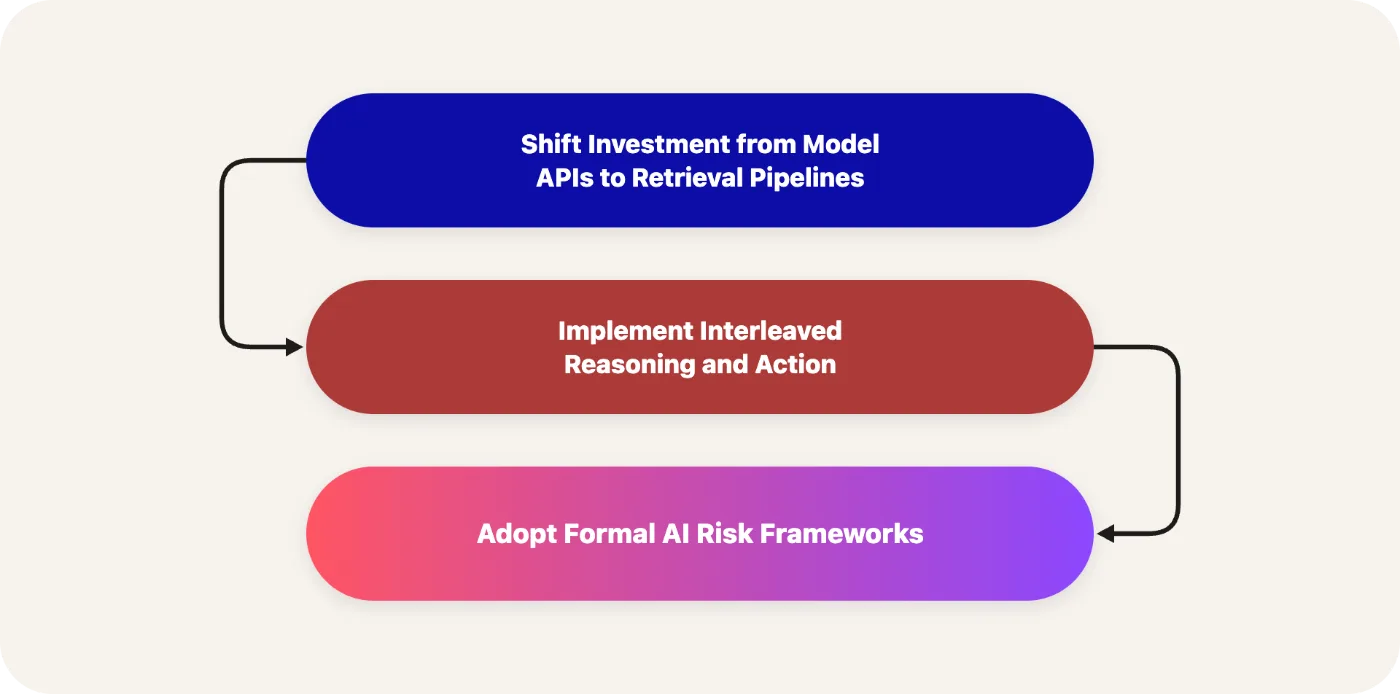
1. Shift Investment from Model APIs to Retrieval Pipelines
Instead of paying a premium for the largest models to handle factual queries, invest in advanced RAG paradigms. Move from naive retrieval to modular RAG architectures that include pre-retrieval optimization and post-retrieval reranking (Gao et al., 2023). This ensures that your system remains accurate even if you switch to a smaller, more cost-effective model for the final generation step.
2. Implement Interleaved Reasoning and Action
Adopt the ReAct framework for any multi-step agentic workflow. Require your models to generate explicit reasoning traces and perform external tool-use actions before committing to a final output (Yao et al., 2023). This increases the interpretability of the system and allows your engineering team to debug the reasoning process rather than just tweaking the prompt.
3. Adopt Formal AI Risk Frameworks
Do not wait for a production failure to evaluate system trust. Use the NIST AI 600-1 profile to audit your generative AI systems for design and evaluation risks (NIST, 2024). Establishing these governance boundaries now will protect the organization from the reputational and operational fallout of unmonitored model behavior.
The Strategy of Decoupling
In my view, the most successful enterprises will be those that decouple their business logic from the specific fortunes of hardware providers or frontier model labs. The market risks facing the giants of the sector are real, but they do not negate the value of the technology itself. They simply clarify where the real value lies.
We are entering a period where the "architect" is more important than the "buyer." The value is in the wiring, the data pipelines, and the reasoning logic. The hardware is just the fuel. When you focus on the system rather than the model, you create a strategic advantage that is immune to market volatility. The future belongs to those who build smart architectures on top of commodity intelligence.
References
- Chen, X. S., Huang, Q., Davison, R. M., & Hua, Z. (2015). What Drives Trust Transfer? The Moderating Roles of Seller-Specific and General Institutional Mechanisms. International Journal of Electronic Commerce. DOI: 10.1080/10864415.2016.1087828
- Gao, Y., Xiong, Y., Gao, X., Jia, K., Pan, J., Bi, Y., Dai, Y., Sun, J., Wang, M., & Wang, H. (2023). Retrieval-Augmented Generation for Large Language Models: A Survey. arXiv Preprint. https://arxiv.org/abs/2312.10997
- Lewis, P., Perez, E., Piktus, A., Petroni, F., Karpukhin, V., Goyal, N., Küttler, H., Lewis, M., Yih, W.-t., Rocktäschel, T., Riedel, S., & Kiela, D. (2020). Retrieval-augmented generation for knowledge-intensive NLP tasks. Advances in Neural Information Processing Systems (NeurIPS), 33, 9459-9474. https://arxiv.org/abs/2005.11401
- National Institute of Standards and Technology. (2024). Artificial Intelligence Risk Management Framework: Generative Artificial Intelligence Profile (NIST AI 600-1). U.S. Department of Commerce. https://nvlpubs.nist.gov/nistpubs/ai/NIST.AI.600-1.pdf
- Nguyen, T. H., Wang, X., Utomo, D. S., Gage, E., & Xu, B. L. (2025). Circular bioeconomy and sustainable food systems: What are the possible mechanisms?. Cleaner and Circular Bioeconomy. DOI: 10.1016/j.clcb.2025.100145
- Yao, S., Zhao, J., Yu, D., Du, N., Shafran, I., Narasimhan, K., & Cao, Y. (2023). ReAct: Synergizing reasoning and acting in language models. International Conference on Learning Representations (ICLR). https://arxiv.org/abs/2210.03629